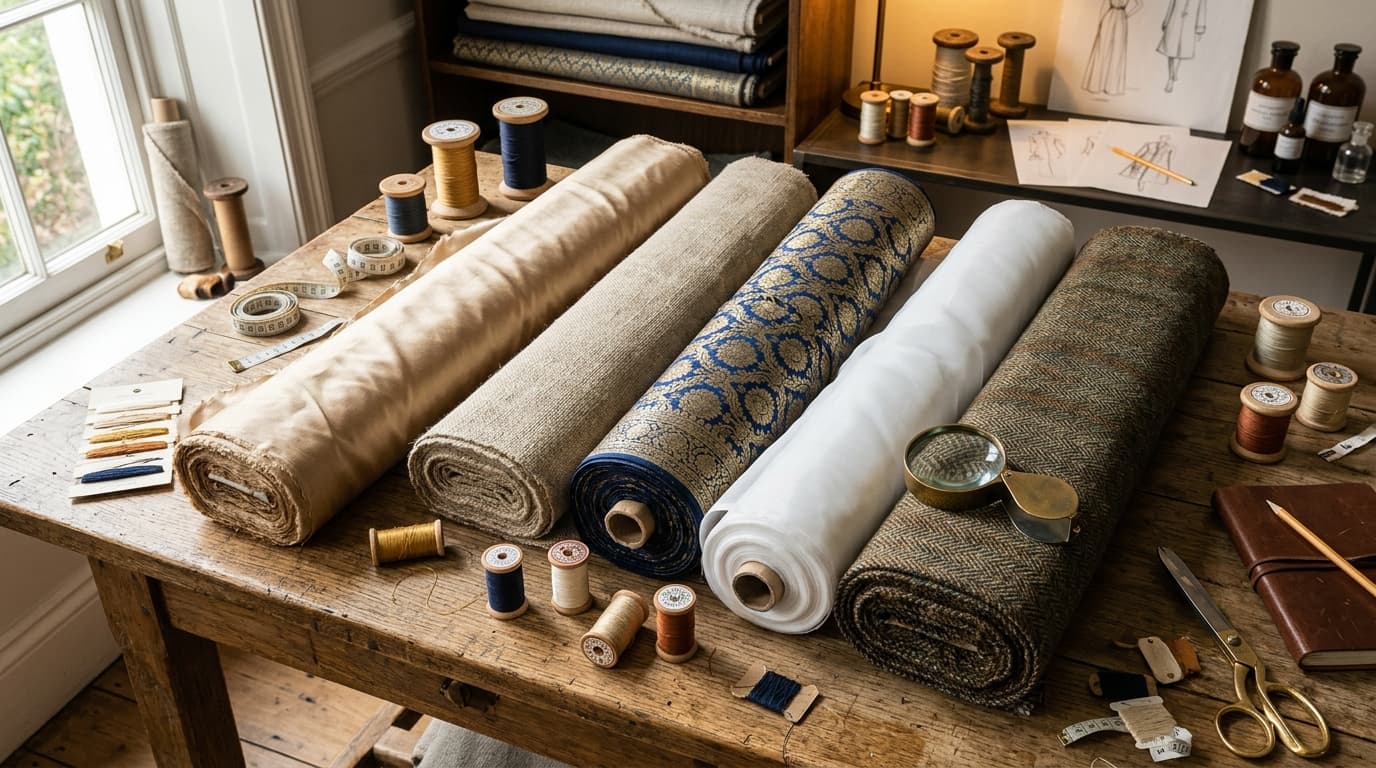
Why Great Design Starts with Textile Intelligence
You can create the most exquisite sketch in the world, but if you choose the wrong textile, the resulting garment will be an utter failure. A design meant for structured boxy tailoring will collapse in limp rayon, while a flowing Bohemian gown will look rigid and bulky in heavy canvas. For every fashion designer, understanding the fundamental science of fibers, yarns, weaves, and finishes is an essential superpower.
1. The Primary Fiber Families
Textile fibers are classified into three major origins, each possessing distinct thermal, tensile, and aesthetic properties:
Natural Natural Fibers:
- Cotton: Highly breathable, absorbent, skin-friendly, but prone to shrinkage and creasing.
- Silk (Mulberry, Tussar, Muga, Chanderi): The queen of luxury fibers with high tensile strength, natural triangular prism luster, and supreme drape versatility.
- Linen: Spun from flax plant stalks; exceptionally cool in summer heat, with distinct rustic slub texture and high stiffness that softens over time.
- Wool & Pashmina: High crimp insulation, moisture-wicking natural elasticity, ideal for winter coats, suits, and knitwear.
Regenerated Cellulose Fibers:
Derived from processed wood pulp (bamboo, eucalyptus, beechwood). Examples include Viscose Rayon, Modal, and Tencel/Lyocell. They offer silk-like breathability, deep dye saturation, and fluid cascade drapes with lower manufacturing cost.
Synthetic Synthetic Fibers:
Polyester, Nylon, and Spandex (Elastane). Resistant to wrinkles and tears, non-absorbent, highly durable, but non-breathable unless engineered with high-tech micro-vents.
2. Understanding Weave Structures & Fabric Falls
How the warp (vertical) and weft (horizontal) yarns interlace determines the texture, strength, and fall of the cloth:
- Plain Weave (Tabby): The simplest one-over, one-under interlacing. Produces balanced, durable fabrics like Muslin, Chiffon, Organza, Georgette, and Poplin.
- Twill Weave: Recognized by its diagonal rib texture. Highly durable and soil-resistant; forms the backbone of Denim, Gabardine, and Tweed.
- Satin / Sateen Weave: Long floating yarns on the surface produce high sheen and low friction, creating smooth fluidity in bridal satin, charmeuse, and duchess satin.
- Jacquard Weave: Complex loom control enabling intricate woven patterns directly into the cloth, including Brocades, Banarasi weaves, and Damasks.
"When selecting fabric, always test the GSM (Grams per Square Meter), perform a stretch recovery check, and hold 2 meters of the cloth by the selvedge to observe its natural gravitational drape before placing wholesale orders." — SIF Textile Lab