The Urgent Imperative for Conscious Design
The global textile and fashion industry is responsible for nearly 10% of global carbon emissions and millions of tons of landfill waste each year. In conventional garment manufacturing, up to 15% to 20% of fabric is discarded on the cutting room floor as useless scrap offcuts. In an era facing climate change and resource depletion, the next generation of fashion designers must champion ethical stewardship, circularity, and zero-waste pattern innovations.
1. Principles of Zero-Waste Pattern Cutting (ZWPC)
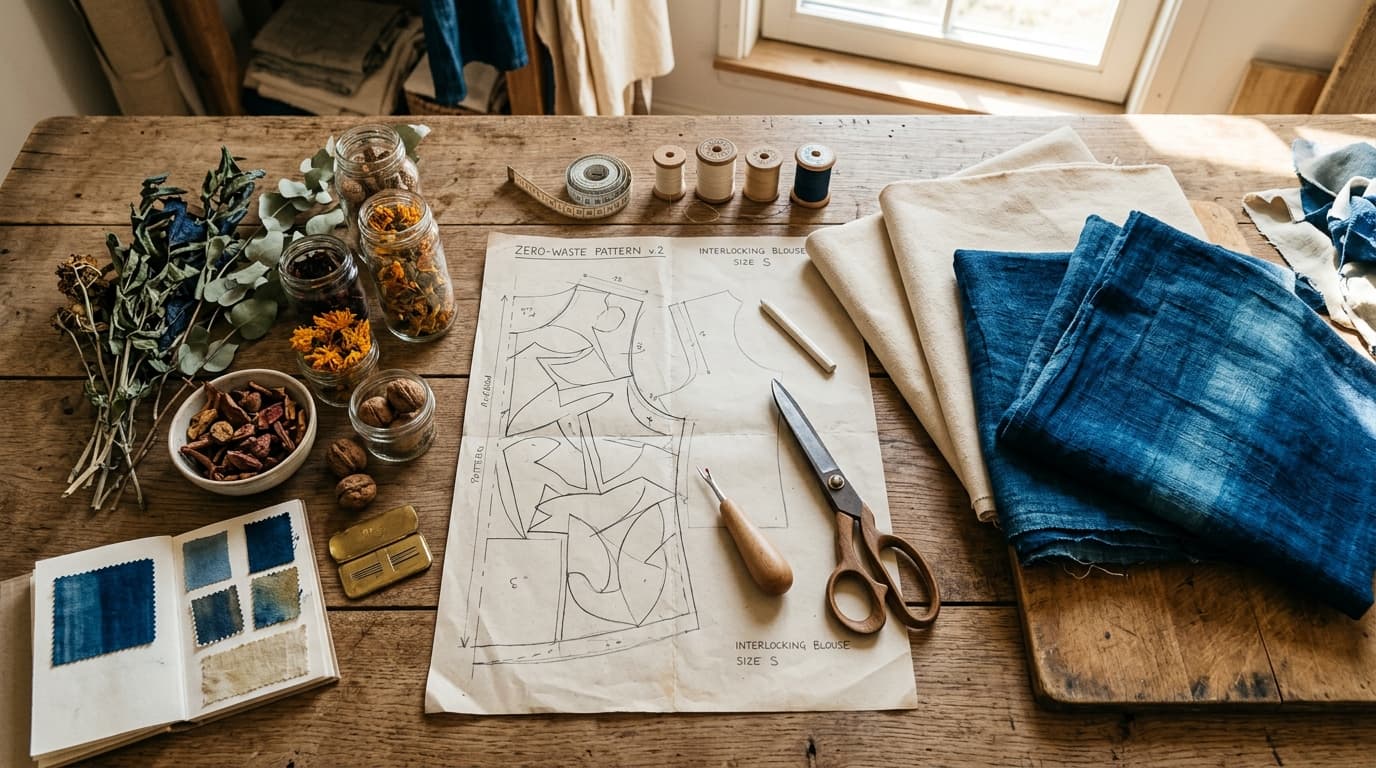
Zero-Waste Pattern Cutting treats the entire roll of fabric as an interlocking mathematical puzzle (similar to a tangram). Not a single square inch of cloth is thrown away into waste bins.
Core Zero-Waste Engineering Strategies:
- Tessellation Layouts: Designing pattern pieces whose negative shapes become functional components of another part of the garment (e.g., the cutout from an armscye becomes an internal pocket bag or collar stand).
- Geometric Fold Draping: Utilizing rectangular and square modules that fold, pleat, and drape around the torso without diagonal curving scrap loss.
- Selvedge-to-Selvedge Utilization: Designing garment widths that correspond exactly to standard loom widths (44 inches or 60 inches), eliminating side edge trim waste.
"True sustainability in fashion is not about buying organic cotton tags; it begins on the pattern cutting table where designers design out waste before the scissors ever touch the fabric." — SIF Sustainability Lab
2. Circular Fashion Lifecycle: Designing for Disassembly
A circular fashion economy ensures that when a garment reaches the end of its wearable lifespan, it can be seamlessly disassembled, recycled, or biodegraded back into the earth without toxic chemical persistence.
- Mono-Materiality: Using 100% pure natural fibers (100% cotton, 100% silk) stitched with matching cotton threads, making fiber-to-fiber recycling effortless.
- Biodegradable Natural Dyes: Utilizing plant-derived dyes (indigo, madder root, pomegranate rind, turmeric, marigold) that release zero harmful heavy metals into waterways.
- Upcycling Heirloom Sarees: Reclaiming vintage pure silk and zari sarees to create contemporary couture jackets, corset tops, and bespoke structured evening capes.
3. The Commercial Value of Ethical Branding
Modern luxury consumers actively seek out brands with transparent supply chains and ethical values. Communicating your zero-waste pattern stories, highlighting karigar fair-wage standards, and offering lifetime repair services transforms your brand from a commodity clothing seller into a respected, forward-thinking fashion institution.