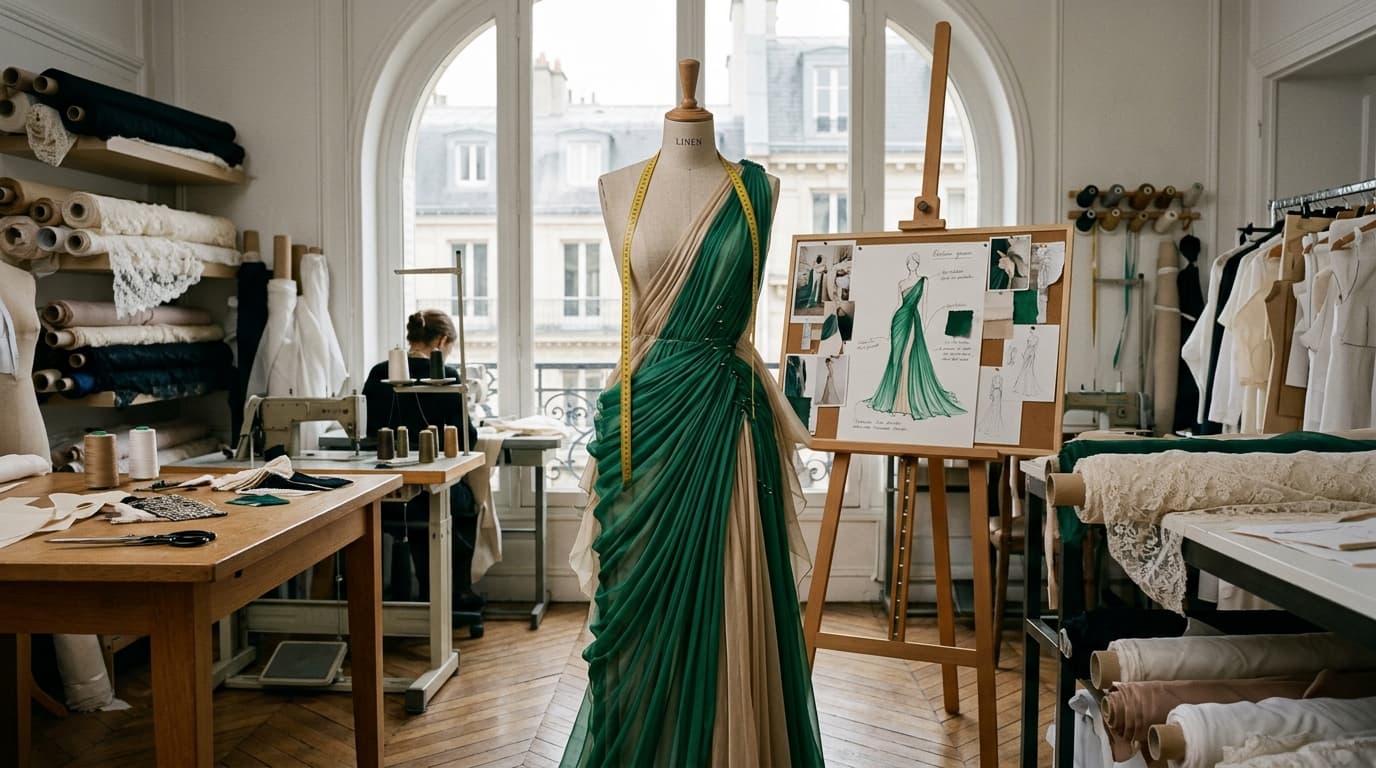
The Sculptural Soul of Haute Couture
While flat pattern drafting relies on mathematical rulers, paper, and calculation, fashion draping is pure sculptural intuition. Pioneered by legendary couturiers like Madeleine Vionnet, Madame Grès, and Cristóbal Balenciaga, draping involves pinning and manipulating actual fabric directly onto a three-dimensional dress mannequin to develop innovative silhouettes that defy standard drafting rules.
1. The Physics of Fabric Flow on the Dress Form
When you hold a piece of textile in your hands, it possesses its own unique weight, hand feel, tensile elasticity, and drape coefficient. Flat drafting cannot always predict how a heavy 40-momme silk crepe will cascade compared to a crisp silk organza or a stretchy modal jersey. By working directly on the dress form, the designer establishes an immediate dialogue with the textile.
Preparation Steps for Professional Draping:
- Padding the Form: Customizing the dress form with padding layers to match the exact physical proportions and asymmetries of the intended muse or client.
- Applying Style Tape: Marking baseline reference lines — Centre Front, Centre Back, Apex Line, Waistline, and Princess Curves — using colored twill tape.
- Grainline Alignment: Tearing or thread-pulling muslin to ensure that warp and weft grains are perfectly perpendicular before pinning.
"Draping is listening to the fabric. You do not force the cloth to obey you; you discover where it naturally wants to fold, fall, and sculpt around the human form." — SIF Atelier Faculty
2. Classical Draping Techniques
Mastering couture draping encompasses several advanced manipulation methods:
- Bias Cowl Drapes: Cutting fabric on the true 45-degree bias grain to create soft, rippling waterfalls of fabric across necklines or back plunge cutouts.
- Architectural Pleating: Folding sharp origami-inspired sunburst pleats and securing them with invisible stay-tapes from inside the lining.
- Grecian Gathers & Shirring: Compressing yards of fine chiffon into tiny micro-gathers anchored to an internal structural boned corset.
- Twisted Knotting & Ruche Volumes: Creating organic, sculptural focal points across waistlines and shoulder apexes.
3. Translating Draped Muslin into Production Patterns
Once the three-dimensional drape satisfies the designer’s aesthetic vision, it must be digitized or transferred to flat cardstock for cutting and manufacturing. The draped muslin piece is unpinned carefully, pressed flat on an ironing table, and the pin marks are true-lined using tailor curves and rulers. Seam allowances and grainline indicators are marked precisely, yielding a production-ready couture pattern.